
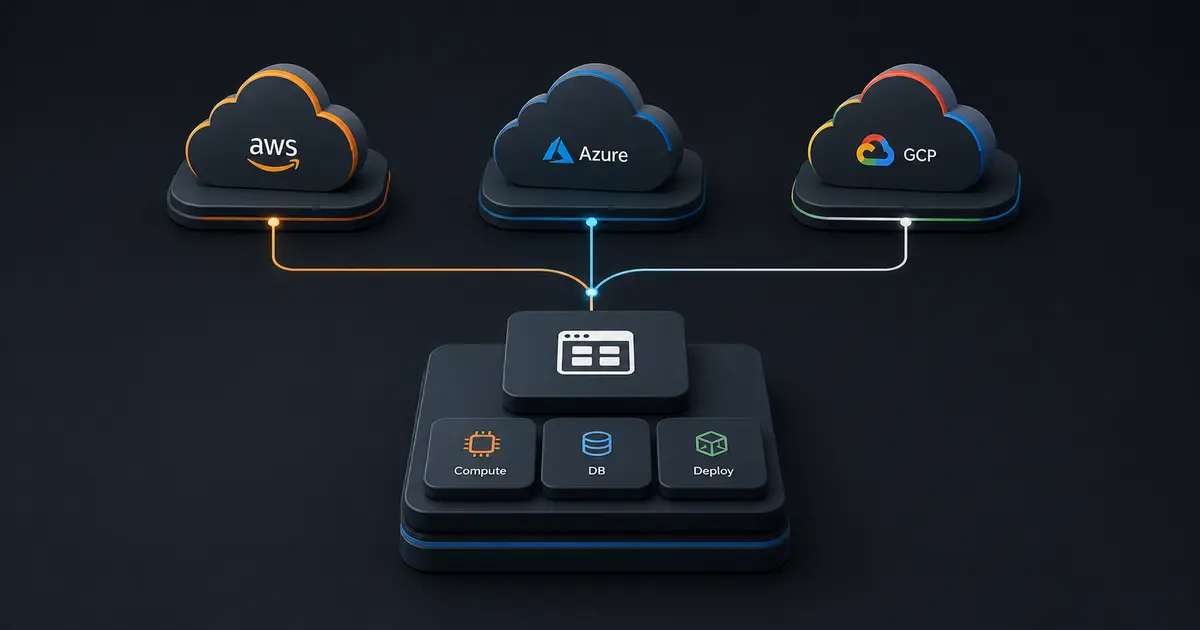
TL;DR: AWS is often the broadest default for startups that want ecosystem depth and hiring availability. Azure is compelling for Microsoft-centric teams and enterprise procurement. Google Cloud is strong for data, analytics, Kubernetes, and AI-oriented workloads. The best provider is the one your team can operate securely and affordably for the next two years.
The provider is not the architecture
AWS, Microsoft Azure, and Google Cloud can all run common startup workloads: web applications, APIs, databases, object storage, containers, queues, analytics, and machine learning. Switching providers rarely fixes an unclear domain model, oversized instances, missing observability, or unsafe deployment process.
The decision should be based on the workload, team, commercial context, and operational maturity. Startups should optimize for a reliable path to product-market fit, not for collecting every managed service.
Compare the providers by fit
| Provider | Common strengths | Typical fit |
|---|---|---|
| AWS | Broad service catalog, mature ecosystem, large hiring pool, flexible infrastructure choices | General-purpose SaaS, global products, teams already familiar with AWS |
| Azure | Microsoft identity, enterprise agreements, .NET and Windows integration, strong hybrid story | Microsoft-centric organizations and enterprise buyers |
| Google Cloud | Data platforms, analytics, Kubernetes expertise, and AI services | Data-heavy, Kubernetes-oriented, and AI-first products |
These are directional patterns, not guarantees. Each provider changes products and pricing frequently, so validate current regional availability and pricing before committing.
Start with the workload map
Document the services your product actually needs:
- compute for web, API, workers, and scheduled jobs,
- relational or non-relational storage,
- object storage and content delivery,
- queues and event delivery,
- identity and secrets,
- logs, metrics, traces, and alerts,
- backups, recovery, and compliance controls.
Then define non-functional requirements: regions, data residency, latency, availability target, recovery point objective, recovery time objective, and expected traffic shape. This turns a provider debate into an architecture comparison.
Team skills and hiring matter more than feature lists
Cloud platforms are complex operating environments. A provider with a service that looks perfect on paper can be expensive if nobody on the team understands networking, IAM, backups, and failure modes. Favor the platform where your engineers can troubleshoot at two in the morning.
Hiring availability also affects delivery. AWS and Azure skills may be easier to source in some markets, while a data or Kubernetes team may prefer Google Cloud. Ask which tools your existing CI, observability, security, and infrastructure-as-code workflows already support.
Compare startup credits carefully
Startup credits can reduce early cash cost, but they are temporary and often restricted by program terms. Do not select a provider only because the initial credit is larger. Model the steady-state bill after credits expire, including data transfer, managed database, logs, storage requests, NAT or private networking, and support.
Create a monthly cost model with a low, expected, and peak scenario. A simple spreadsheet is better than a vague belief that cloud will be cheap.
Managed services and portability
Managed services improve delivery speed, but every proprietary dependency affects future migration. Use managed databases and queues when they provide clear operational value. Keep application contracts portable where practical, and isolate provider-specific code behind adapters.
Containers and Kubernetes do not automatically create portability. IAM, networking, observability, storage classes, ingress, load balancing, and deployment controllers still differ. Portability is a business decision with an ongoing cost, not a checkbox.
For infrastructure that must remain repeatable, use Terraform, AWS CDK, or another supported infrastructure-as-code approach. Our Terraform AWS environments guide covers safe state, modules, promotion, and drift detection.
Networking and hidden costs
Many startup bills grow through networking rather than compute. Watch data transfer between zones, public egress, NAT gateways, load balancers, managed firewall services, and log ingestion. Design traffic paths before production. Keep large object transfers on object storage and content delivery instead of routing them through an application server.
Set budgets, alerts, tagging or labels, and ownership for every resource. Review unused disks, snapshots, idle IP addresses, oversized databases, and verbose logs. Cost control is an operational habit, not a quarterly emergency.
AI and data workloads
Google Cloud may be attractive for teams centered on analytics, BigQuery, or Google AI services. AWS offers a broad set of storage, compute, and AI options and a large ecosystem. Azure can be compelling when the organization already uses Microsoft identity, data, security, and enterprise agreements.
For an AI startup, compare model availability, inference regions, GPU quota, vector search, data egress, evaluation tooling, and support. Separate the model layer from the product API so you can change providers or use more than one model without moving the entire application.
Reliability and disaster recovery
Do not confuse a provider's global footprint with your application's resilience. Define what happens when a region, database, queue, identity provider, or deployment pipeline fails. Back up data, test restoration, and document the recovery sequence.
Startups usually benefit from a simple single-region architecture with multi-zone redundancy before jumping to multi-region complexity. Add a second region when the business requirement justifies the cost and the team can test failover. Our active-passive disaster recovery guide explains the operational implications.
Security baseline
Use separate accounts, subscriptions, or projects for environments. Apply least-privilege IAM, centralize secrets, restrict network access, encrypt sensitive data, and enable audit logs. Protect the CI identity because it can often modify the entire environment.
Keep production changes reviewed and reproducible. Avoid giving every developer administrator access simply because the first version is small. Startup speed and basic security are compatible when the defaults are automated.
A practical selection process
- Define the workload and non-functional requirements.
- List the three providers' equivalent services and regional limits.
- Price the expected and peak architecture after credits expire.
- Build a small production-like proof of concept.
- Test deployment, backup restoration, observability, and a failure scenario.
- Choose one primary provider and document exit assumptions.
The proof of concept should measure deployment time, p95 latency, database operations, data transfer, and operator effort. A cloud choice is also a people and process choice.
Common mistakes
- Choosing from headline service counts.
- Ignoring regional availability or data transfer costs.
- Treating startup credits as permanent pricing.
- Using multiple clouds before the team can operate one reliably.
- Building a nominally portable Kubernetes system with deeply proprietary dependencies.
- Delaying IAM, backups, and observability until after launch.
Production checklist
- Workload, regions, availability, and recovery requirements are documented.
- Steady-state cost is modeled after credits expire.
- Resources have budgets, tags or labels, and owners.
- IAM, secrets, audit logging, backups, and network boundaries are configured.
- Infrastructure is versioned and repeatable.
- Restore and failure tests have been performed.
- Provider-specific dependencies and exit assumptions are documented.
Conclusion
AWS, Azure, and Google Cloud are all capable startup platforms. Choose based on your product workload, people, commercial constraints, and ability to operate securely. SoftwareCrafting’s cloud infrastructure management service and DevOps cloud deployment service can help evaluate the options and build a cost-conscious production foundation.
A reference startup architecture
A small production SaaS does not need every managed service. Begin with a private network, managed relational storage, object storage, one application runtime, a queue for background work, centralized secrets, and an observability baseline. Compare the full request path, including identity, load balancing, logs, backups, and deployment. The surrounding services often matter more than the compute product.
Accounts, costs, and infrastructure as code
Keep production separate from development and experimentation. Use separate accounts, subscriptions, or projects where possible, with centralized billing and short-lived production roles. Give every resource an owner, environment label, cost center, and data classification. Model logs, traces, backups, cross-zone traffic, public egress, NAT, firewalls, and image pulls, not just compute.
Store infrastructure definitions in version control and review plans before production changes. Separate state by environment, protect state storage, restrict destruction, and test new modules in isolation. Include deletion protection, backup configuration, secret references, and drift detection in reviews.
Avoiding premature multi-cloud
Multi-cloud may be required by regulation, contracts, acquisition strategy, or availability goals. It is not automatically safer for a small team. Running two clouds doubles parts of networking, IAM, monitoring, deployment, and incident response. If portability matters, define the exact exit scenario and test data export, DNS changes, image builds, and restore procedures.
Review the choice quarterly using actual cost, support quality, incident history, quota constraints, hiring, and new product requirements. A startup can begin with the provider that minimizes delivery friction and add another later for a specific reason.