
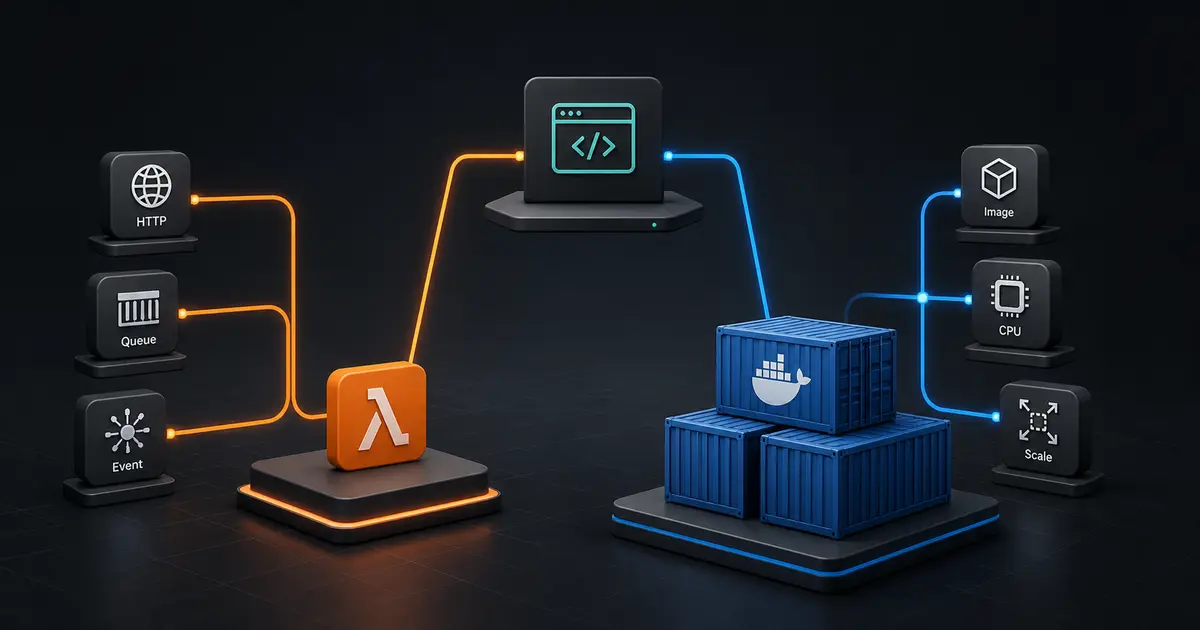
TL;DR: Serverless is a strong fit for event-driven, bursty, short-lived workloads where the team wants less infrastructure management. Containers are better for long-running processes, predictable performance, custom runtimes, streaming connections, and workloads that need explicit resource control. Most real systems use both.
The decision is about operating responsibility
Serverless does not mean “no servers.” It means the provider manages more of the runtime lifecycle, including capacity and much of the host fleet. Containers package the application and its dependencies, but your platform still manages scheduling, networking, scaling, images, and health behavior.
The best choice depends on request duration, traffic shape, startup sensitivity, connection lifetime, runtime requirements, and how much operational control the team needs.
Core differences
| Concern | Serverless functions | Containers |
|---|---|---|
| Scaling | Provider-managed invocation scaling | You define replicas and autoscaling |
| Billing | Often per invocation and duration | Resource allocation and runtime capacity |
| Startup | Cold starts may occur | Warm processes, slower deployment startup |
| Runtime | Platform constraints | Broad language and OS control |
| State | External by design | Still should be external for resilience |
| Long connections | Often constrained | Natural fit for workers and streams |
| Operations | Less host management | More control and more responsibility |
Neither model guarantees low cost or high availability automatically. A badly designed function can be expensive, and a container platform can be simple or overloaded depending on its boundaries.
Good serverless workloads
Use functions for webhook handlers, image resizing, scheduled cleanup, queue consumers, lightweight APIs, and bursty workloads where idle capacity would be wasteful. They work well when each invocation is bounded, idempotent, and can persist state to a database or object store.
Events should be durable where loss matters. A function triggered directly by an HTTP request may fail after the client disconnects. A queue or event stream can provide retries, dead-letter handling, and backpressure.
Design each function around one business capability rather than splitting every line of code into a separate deployment. Excessive fragmentation creates difficult local testing, permission sprawl, and slow cross-function workflows.
Good container workloads
Containers fit APIs with steady traffic, background workers, WebSocket or SSE connections, custom binaries, large dependencies, and processes that need predictable warm memory. They are also useful when the team already has mature Docker, CI, orchestration, and observability practices.
A container can run on a managed service such as ECS, a Kubernetes cluster, or a simpler single-host platform. Start with the least operationally complex environment that meets availability and scaling needs.
Cold starts and latency
Cold starts depend on runtime, package size, initialization work, network configuration, and provider behavior. Measure cold and warm p50 and p95 latency for the actual function, not a minimal hello-world example. Keep initialization small, reuse clients across invocations, and provision warm capacity only when the business requires predictable latency.
Containers avoid function cold starts after a process is running, but deployments, autoscaling, image pulls, and node capacity also introduce latency. A container platform needs startup and readiness probes so traffic does not reach a process before it is ready.
Cost modeling
Model cost from workload shape:
- invocations or requests,
- average and peak duration,
- memory or CPU allocation,
- concurrency,
- idle time,
- network egress,
- logs and metrics,
- queue, database, and storage operations.
Serverless is often economical for sporadic traffic, but high sustained utilization may be cheaper on containers. Containers can also waste money when autoscaling is too slow, minimum replicas are too high, or logs and NAT traffic dominate the bill.
Use real usage samples and include the cost of engineering and operations. A slightly more expensive runtime may be cheaper for a small team if it avoids weeks of platform maintenance.
State, retries, and idempotency
Both models should treat compute as disposable. Store authoritative state in a database, object storage, or durable queue. A function or container can restart at any time.
Retries create duplicate work unless the operation is idempotent. Use an idempotency key for payments, emails, and external side effects. Record a job or event ID and make repeated processing safe. Configure maximum retries and a dead-letter path rather than retrying forever.
Security boundaries
Grant each function or service only the permissions it needs. Containers need image scanning, non-root execution, dependency updates, network restrictions, and runtime monitoring. Functions need least-privilege execution roles, input validation, concurrency controls, and protection from event amplification.
Keep secrets out of images and source repositories. Validate file uploads and user-controlled URLs before a function or container makes an outbound request. Separate development and production accounts or projects, and audit who can deploy code or change runtime permissions.
Deployment and observability
For functions, version handlers, configure aliases or traffic shifting, and monitor invocation errors, throttles, duration, concurrency, retries, and dead-letter events. For containers, monitor replica health, CPU and memory, restarts, queue depth, request latency, and deployment failures.
Use correlation IDs across API requests, events, functions, and workers. Logs should describe operation, tenant, request ID, outcome, and latency without exposing credentials or sensitive payloads.
A hybrid architecture
A typical SaaS product might use a containerized API for interactive requests, serverless functions for file processing and scheduled cleanup, a queue for durable work, and managed databases for state. This avoids forcing a single runtime onto every workload.
Keep the boundary intentional. If a function calls a container synchronously for every request, the system may inherit the latency and failure modes of both without gaining much value. Use events where asynchronous behavior is acceptable and keep contracts versioned.
Migration strategy
Move one bounded workload first. Capture baseline latency, error rate, cost, and operational effort. Build a rollback path and run old and new implementations in parallel when correctness can be compared. Do not migrate a critical payment or identity flow without replay tests and failure drills.
The existing serverless computing guide covers the fundamentals, while the Docker and Kubernetes guide covers container progression.
Common mistakes
- Choosing serverless because it sounds cheaper without modeling duration and egress.
- Choosing Kubernetes when a managed container service is enough.
- Keeping state in local function or container memory.
- Retrying payment or email side effects without idempotency.
- Ignoring cold starts, image pulls, and readiness behavior.
- Giving every function or container broad cloud permissions.
Checklist
- Workload duration, concurrency, and traffic shape are measured.
- Startup and p95 latency requirements are explicit.
- State is external and side effects are idempotent.
- Cost includes network, logs, storage, and operator effort.
- Least-privilege permissions and secret handling are implemented.
- Retry, dead-letter, health, and rollback behavior are tested.
- Metrics and traces cover both runtime and business outcomes.
Conclusion
Serverless and containers are complementary deployment models. Use serverless for bounded event work and containers for workloads that need process control, steady performance, or long-lived connections. SoftwareCrafting’s cloud infrastructure management service can help map workloads to the right runtime and design a migration path that keeps reliability visible.