
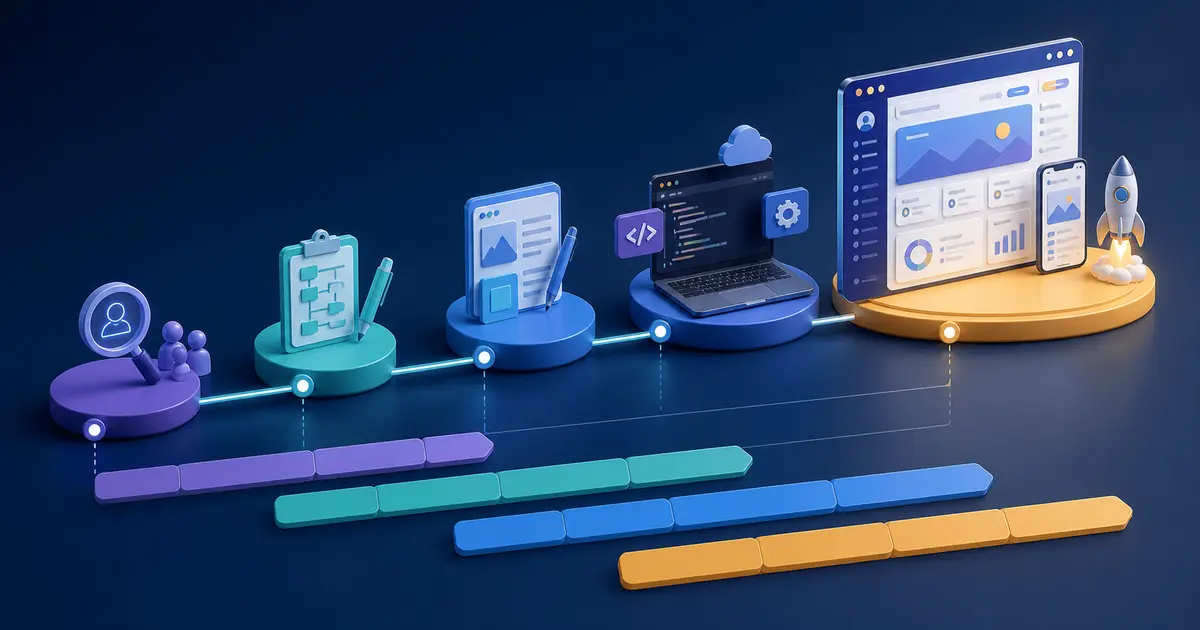
TL;DR: A custom web app can take anywhere from one week to five months depending on scope. The timeline is mostly driven by requirement clarity, backend complexity, integrations, QA depth, design readiness, and how quickly decisions are made. A serious SaaS dashboard or workflow product should be planned in milestones, not guessed from a feature list.
Key Takeaways
- A small landing site can take 1-3 weeks when content and design direction are ready.
- A focused web app MVP often takes 4-8 weeks.
- A SaaS dashboard with roles, billing, admin, and reporting often takes 8-14 weeks.
- Integration-heavy products can take 12-20 weeks because third-party systems create dependency risk.
- Discovery, QA, deployment, and launch stabilization should be included in the timeline.
Typical Web App Timelines
| Scope | Planning Timeline | What Usually Fits |
|---|---|---|
| Landing site or marketing website | 1-3 weeks | pages, responsive UI, forms, analytics, deployment |
| Focused web MVP | 4-8 weeks | auth, dashboard, database, core workflow, admin basics |
| SaaS dashboard | 8-14 weeks | roles, billing, onboarding, reporting, permissions, support flows |
| Integration-heavy app | 12-20 weeks | CRM, ERP, payments, maps, AI, webhooks, background jobs |
| Rebuild or rescue project | 6-16 weeks | audit, stabilization, refactor, migration, feature delivery |
These are useful planning ranges, not promises. A two-screen internal app with a complex ERP integration can take longer than a polished dashboard with a simple backend.
What Makes A Web App Take Longer?
| Driver | Why It Adds Time |
|---|---|
| Unclear scope | engineers wait for decisions or rebuild finished work |
| Missing design | UI and product decisions move into development time |
| Complex roles | permissions need careful testing and edge-case handling |
| Integrations | external APIs create unknowns, rate limits, and failure states |
| Data migration | old systems need cleanup, mapping, and rollback plans |
| Payments | subscriptions, invoices, tax, coupons, and webhooks need testing |
| Performance requirements | caching, query tuning, and monitoring become part of delivery |
| Compliance needs | audit logs, access control, and data retention add design work |
A Practical Milestone Plan
For most founder-led web apps, the project should be planned in weekly milestones:
| Phase | Duration | Output |
|---|---|---|
| Discovery and scope lock | 2-5 days | requirements, workflows, assumptions, milestones |
| UX and technical planning | 3-7 days | screens, data model, API plan, risk register |
| Core build | 3-10 weeks | working app, backend, auth, workflows |
| Integrations and edge cases | 1-5 weeks | payments, third-party APIs, background jobs |
| QA and launch prep | 1-3 weeks | bug fixes, staging, analytics, deployment, handover |
| Stabilization | 1-2 weeks | production support and post-launch fixes |
How To Speed Up A Custom Web App Build
You can reduce timeline without reducing quality by making decisions easier for the build team:
- Share the exact user roles and must-have workflows.
- Separate version-one features from later roadmap ideas.
- Provide sample data, API docs, brand assets, and reference products.
- Approve one product owner who can answer questions quickly.
- Avoid adding new integrations after build starts.
- Ship a focused first version before trying to cover every edge case.
- Use existing services for auth, payments, email, analytics, and hosting when appropriate.
What Not To Compress
Do not compress QA, deployment planning, security review, or handover just to hit an artificial launch date. Those are the parts that protect the product after it goes live.
If timeline is tight, reduce scope instead. A smaller product that launches cleanly usually creates more business value than a larger product that launches unstable.
When To Hire SoftwareCrafting
SoftwareCrafting is a fit when you need a senior web app team that can plan scope, build the product, handle backend complexity, and launch with SEO, performance, analytics, and maintainability in mind.
Review our full-stack web development services, compare pricing models, or send your project brief for a practical delivery plan.
Frequently Asked Questions
How long does it take to build a custom web app?
A small web app can take 4-8 weeks. A SaaS dashboard or integration-heavy product often takes 8-20 weeks depending on scope, dependencies, and QA needs.
Can a web app be built in two weeks?
Yes, but only when the scope is narrow, content is ready, integrations are minimal, and decisions are fast. Two weeks is not realistic for a complex SaaS product.
What causes timeline delays?
Unclear requirements, delayed feedback, changing scope, unavailable API access, missing data, and underplanned QA are common causes.
Should I build an MVP first?
Usually yes. A focused MVP validates the workflow and market need before you spend heavily on edge cases and advanced automation.
Can SoftwareCrafting take over a delayed web app?
Yes. We can audit the current codebase, stabilize delivery, prioritize the remaining scope, and create a realistic launch plan.