
TL;DR: Start with one measurable workflow, not a general-purpose chatbot. Separate tenant data, model orchestration, retrieval, billing, and observability from the beginning. Launch a narrow vertical slice, measure answer quality and unit economics, and add autonomy only after reliability is proven.
What makes an AI SaaS product different?
An AI SaaS product combines normal software delivery with probabilistic behavior and variable infrastructure cost. A standard SaaS application can often validate a request with deterministic rules. An AI feature may produce a different answer for the same input, call several services, consume different amounts of tokens, and need human review.
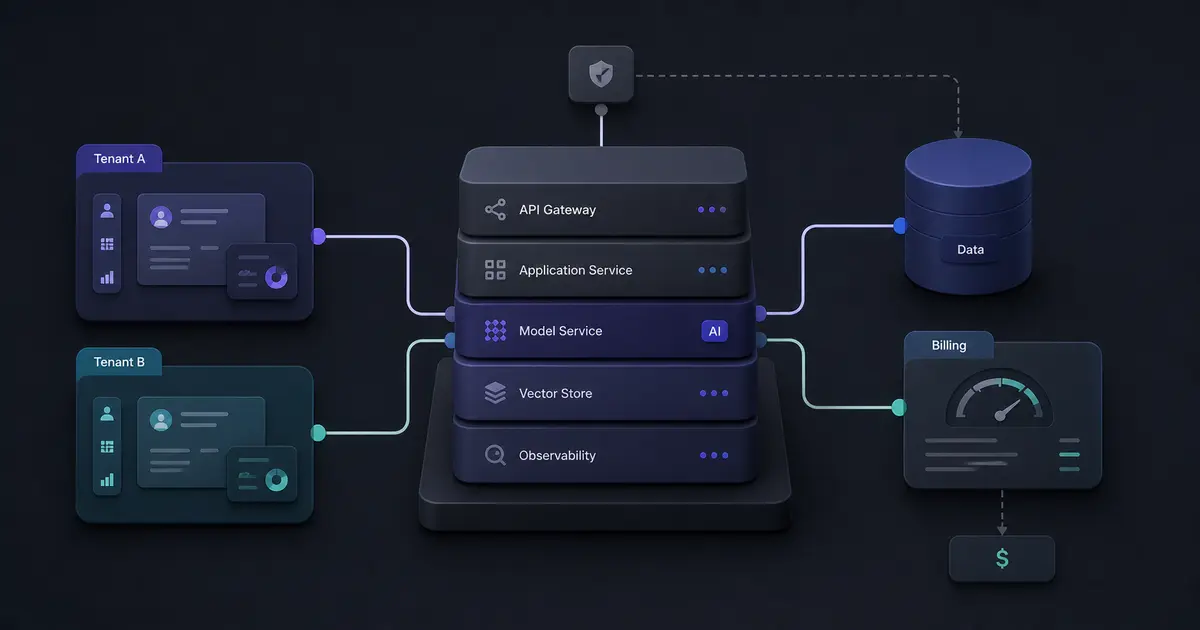
That changes the architecture. You need a product surface, a tenant boundary, a model gateway, prompt and tool orchestration, optional retrieval, usage metering, evaluation, and operational controls. The model is only one component.
Before selecting a framework, define the job your product completes. “AI assistant for businesses” is too broad. “Extract obligations from vendor contracts and route exceptions to a reviewer” is specific enough to measure.
Validate the use case before building the platform
Write down the current workflow and its measurable pain. Identify the input, expected output, acceptable error rate, review step, and business value. Collect representative examples, including difficult cases, missing data, multilingual inputs, and adversarial content.
Define a success scorecard:
| Dimension | Example question |
|---|---|
| Quality | Does the result contain the right facts and citations? |
| Speed | What is the p50 and p95 response time? |
| Cost | What does one successful task cost to run? |
| Safety | When must the system refuse or ask for review? |
| Adoption | Do users complete the workflow faster than before? |
Build a small evaluation set before writing a complex agent. It prevents a polished interface from hiding weak results.
A practical AI SaaS architecture
A useful first production architecture has these layers:
- The web or mobile client handles authentication, workspaces, files, feedback, and review states.
- The application API enforces tenant authorization and coordinates durable jobs.
- The AI orchestration layer selects models, builds prompts, calls tools, and validates outputs.
- The knowledge layer stores source documents, metadata, chunks, embeddings, and citations.
- The data layer stores tenant records, configuration, usage events, and audit history.
- The operations layer handles queues, observability, evaluation, rate limits, and alerts.
Keep model calls behind a provider interface. Your application should ask for a task such as extractContractTerms, while one adapter handles the selected model provider. This makes it possible to compare quality, latency, and cost without rewriting the product.
Choose a stack that matches the product
For a TypeScript team, a practical stack could include Next.js for the product interface, Node.js for APIs and workers, PostgreSQL for transactional data, object storage for documents, and a queue for long-running jobs. A vector extension or managed vector store can support retrieval. Use a hosted model API initially unless a regulatory, latency, or cost requirement justifies self-hosting.
The right choice depends on the workflow. A document extraction product needs durable file processing and review states. A live voice assistant needs low-latency streaming and media infrastructure. A coding tool needs repository access, sandboxing, and strict permission boundaries. There is no universal AI SaaS stack.
Design multi-tenancy from day one
Every user, project, document, embedding, conversation, usage event, and audit record should carry an unambiguous tenant scope. Enforce it in the application service and, where appropriate, in PostgreSQL Row-Level Security. Do not rely on a UI filter to protect data.
alter table documents enable row level security;

create policy documents_by_tenant on documents
using (tenant_id = current_setting('app.tenant_id')::uuid);
The database session variable must be set from a verified request identity, never from a client-provided field. Retrieval queries need the same tenant filter as normal SQL queries. A vector search that forgets metadata filtering can leak data even when the relational tables are protected.
Build retrieval that can be inspected
For a knowledge product, ingestion should be a durable pipeline:
- Validate file type and size.
- Store the original in private object storage.
- Extract text with a versioned parser.
- Split content using structure-aware chunking.
- Generate embeddings and attach tenant, document, page, and permission metadata.
- Index the chunks.
- Preserve a link back to the source for citations.
At query time, apply tenant and permission filters before or during vector search. Consider hybrid retrieval for exact identifiers, product codes, and legal terms. Then rerank a small candidate set and pass only the evidence needed for the answer.
Retrieval quality is not the same as answer quality. Measure recall on known questions, citation correctness, groundedness, and refusal behavior. Our guide to RAG evaluation in production covers a useful test structure.
Make model output reliable
Use structured output schemas for business data. Validate the result before writing it to a database or triggering an action. If parsing fails, retry with a bounded policy or send the task to review. Never allow invalid model output to silently become a customer record.
Tool calls need permissions, timeouts, idempotency keys, and confirmation for consequential actions. Prompt injection can appear in uploaded documents, web pages, emails, or user messages. Treat retrieved text as untrusted data and keep system instructions and authorization decisions outside the model's control.
Meter usage and understand cost
AI SaaS pricing fails when teams meter only subscriptions but not variable work. Record model name, input tokens, output tokens, cached tokens, embedding operations, storage, tool calls, and queue time per tenant and task. A usage event should be append-only and reconciled with provider usage where possible.
await usageEvents.insert({
  tenantId,
  task: 'contract_extraction',
  model: result.model,
  inputTokens: result.usage.inputTokens,
  outputTokens: result.usage.outputTokens,
  requestId,
});
Set budget alerts and hard limits. Use smaller models for classification and routing, cache stable context, batch embeddings, and avoid sending the same long document on every turn. Review gross margin per workflow before offering unlimited plans.
Plan the MVP and launch sequence
An effective first release usually has one workflow, one or two integrations, a clear review state, usage visibility, and an admin escape hatch. It does not need autonomous multi-agent orchestration, ten model providers, or a marketplace.
Build in this order:
- Capture real examples and define acceptance tests.
- Implement the deterministic workflow around a model call.
- Add tenant isolation, authentication, and audit events.
- Add evaluation and user feedback before broadening the feature.
- Add billing, quotas, and operational alerts.
- Run a private pilot with manual review.
- Automate only the steps that are consistently reliable.
Security and compliance concerns
Minimize data sent to providers, document retention, and access to prompts and outputs. Encrypt data in transit and at rest. Keep secrets in a managed secret store. Define deletion behavior for source files, embeddings, conversations, backups, and provider logs. If the product handles regulated data, involve legal and security stakeholders before the pilot.
Also protect the product from ordinary SaaS risks: account takeover, broken object authorization, insecure file upload, SSRF through tools, and abuse of expensive model endpoints. AI does not replace baseline application security.
Common failure modes
- Starting with a generic chatbot instead of a measurable job.
- Mixing tenant data in a shared retrieval index without permission filters.
- Shipping without an evaluation dataset.
- Treating model output as trusted database input.
- Offering unlimited usage before calculating unit economics.
- Making every workflow autonomous when a review step is safer.
- Logging prompts and outputs without a data-retention policy.
Production readiness checklist
- One workflow has a measurable acceptance definition.
- Tenant isolation is enforced in every read and write path.
- Model calls, tools, files, and retrieval are observable.
- Structured outputs are validated before persistence.
- Evaluation covers normal, difficult, and adversarial examples.
- Usage is metered per tenant and workflow.
- Quotas, rate limits, timeouts, and budget alerts exist.
- Data retention, deletion, encryption, and provider policies are documented.
Conclusion
Building an AI SaaS product is primarily a systems and product-design problem. The model matters, but durable value comes from a well-defined workflow, trustworthy data boundaries, measurable quality, and economics that work at scale. SoftwareCrafting’s AI and machine-learning integration service helps teams design and implement these production layers. For a broader business planning view, compare the assumptions against our guide to AI integration cost for SaaS products.
Separate synchronous and asynchronous work
Users expect a fast response for a classification or short answer, but document ingestion, exports, batch analysis, and enrichment may take minutes. Put long-running work behind a durable queue. The API should create a job, return its ID, and expose progress, cancellation, and failure state. Store the input reference, workflow version, model configuration, attempt number, and output location so a worker can resume safely.
Prompt and model change management
Treat prompts, tool schemas, retrieval configuration, and model versions as release artifacts. Store a workflow version with every result. If the answer changes, you need to know whether the cause was a model, prompt, chunking, system instruction, or source-document change. Maintain a regression set with expected properties rather than only exact text, and run it in CI for important changes.
Human review and data isolation
Review is a product feature for low-confidence results, regulated decisions, destructive actions, or unusual inputs. Store the original output, reviewer correction, reason, and accepted version. Tenant safety applies to object-storage paths, vector metadata, cache keys, queue payloads, logs, analytics, provider requests, and backups. Add negative tests that attempt cross-tenant reads through every endpoint and background job.
Provider failures and launch gates
Model APIs fail, throttle, return malformed output, and change latency. Configure timeouts and bounded retries with jitter. Use fallbacks only when their quality and data policy are acceptable. Before public launch, require a quality threshold, maximum cost per task, deletion workflow, escalation path, and rollback plan. Track task completion, correction rate, review time, refusal rate, citation clicks, abandonment, and cost per successful outcome.