

TL;DR: AI search visibility begins with ordinary discoverability. Make important pages indexable, server-render meaningful text, keep robots controls intentional, write answer-first passages, use accurate schema that matches visible content, connect related pages with internal links, and measure citation share rather than chasing a special file or meta tag. You cannot force a citation, but you can make your product easier to retrieve, understand, verify, and quote.
Why this matters in 2026
Product discovery is no longer limited to a blue link and a click. Search engines can synthesize answers, and chat products can cite pages in a response. That changes the visibility question from “Do we rank for the keyword?” to “Can a retrieval system find, interpret, trust, and quote the page that answers the question?”
The fundamentals still matter. Google’s documentation for AI features in Search says pages need to be indexed and eligible for snippets, and it recommends crawlable content, internal links, textual content, and structured data that matches visible content. OpenAI’s publisher and developer FAQ explains how OAI-SearchBot affects ChatGPT search visibility, while training controls use a different bot. Anthropic similarly documents ClaudeBot and robots.txt.
The implication is practical: improve the page as a useful, verifiable answer first. AI search features differ in crawling, retrieval, ranking, citation, and freshness, so a tactic that targets one interface may not transfer to another.
Key terms and mental model
| Layer | Question | Implementation focus |
|---|---|---|
| Crawl | Can the system fetch the URL? | Robots, status, sitemap, links, server behavior |
| Index | Can it store and retrieve the content? | Canonical, duplicate control, stable page structure |
| Understanding | Does it know what the page is about? | Headings, entities, schema, explicit relationships |
| Citation | Can it quote a useful passage? | Answer-first copy, precise claims, source references |
| Measurement | Does visibility create qualified discovery? | Citation share, impressions, assisted conversions |
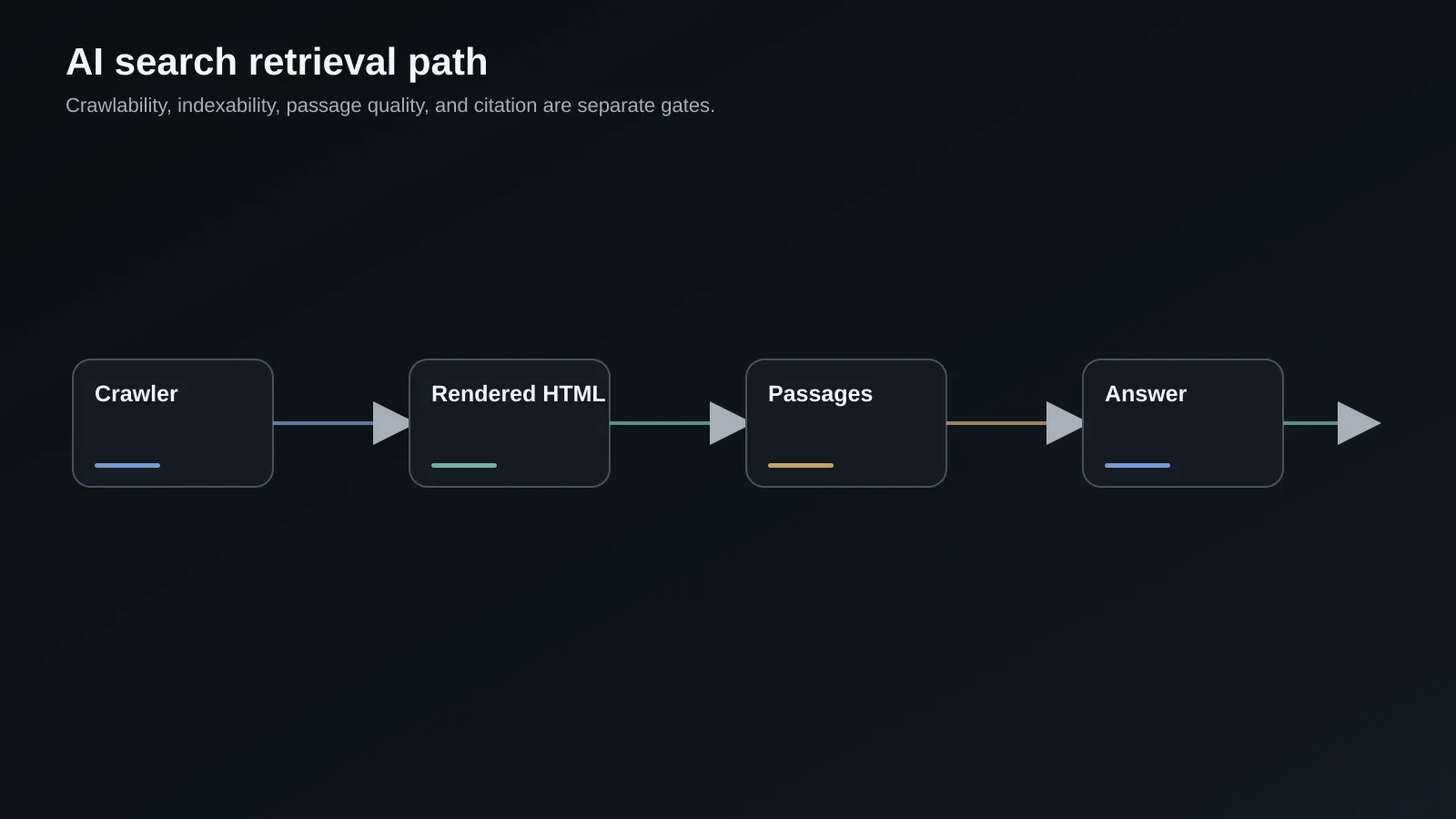
Use this retrieval path:
bot or search request -> robots and HTTP response -> rendered text and metadata
                     -> indexing and passage extraction -> query matching
                     -> answer synthesis -> citation and user visit
JavaScript-heavy rendering can fail at the first or third step. A page that looks complete after client data fetching may expose only a loading shell to a crawler or delayed renderer. Make the core explanation, product facts, and links available in the initial HTML wherever practical.
Make important pages crawlable and renderable
Start with the URL inventory: product pages, use-case pages, documentation, comparison pages, pricing, security, implementation guides, and company or author pages. For each URL, record status code, canonical, indexability, server-rendered text, last modified time, internal links, and conversion action.
Use server rendering or static generation for the content that establishes relevance. It is fine to hydrate a calculator, filter, or interactive demo, but do not hide the page’s definition, key benefits, limitations, and evidence behind a client-only request. Set meaningful titles and descriptions, return a real 200 for canonical pages, and use redirects or 404s consistently.
Robots controls are access policy, not a visibility hack. Check robots.txt, noindex, HTTP headers, CDN rules, authentication, bot challenges, and rate limits together. Allow the crawlers you actually want to reach public content. Separate Googlebot, Google-Extended, OAI-SearchBot, GPTBot, and ClaudeBot according to the data use you accept. Do not block every unknown user agent and assume AI search will still discover your pages.
Write passages that can be cited
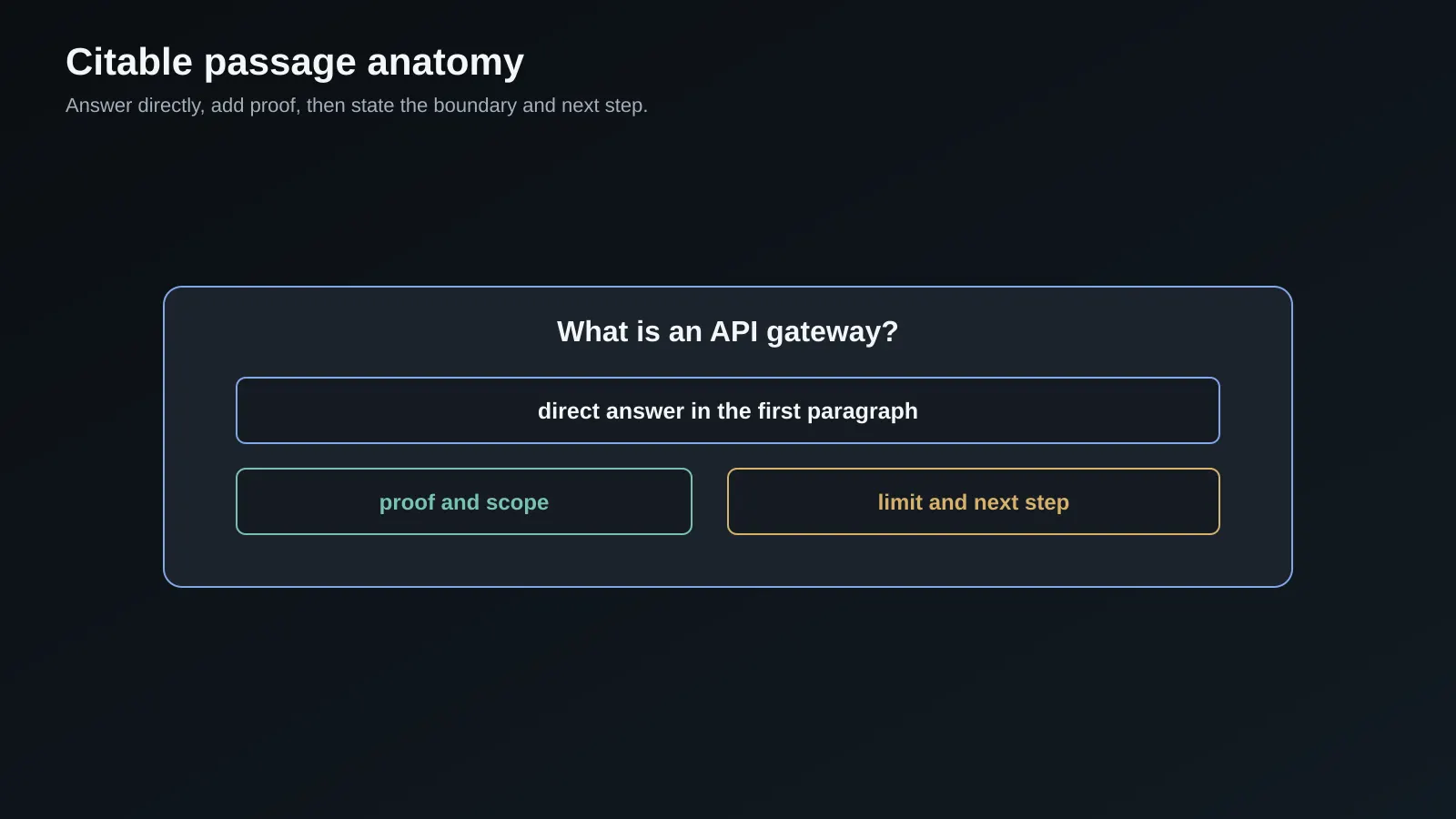
The first 40 to 60 words under a descriptive heading should answer the question directly. Define the object, state who it is for, explain the key condition, and add a verifiable detail. Then expand with implementation, tradeoffs, and examples. This helps a human scan and gives a retrieval system a self-contained unit.
Passage anatomy:
heading: What is an API gateway?
answer: An API gateway is the controlled entry point that routes client
requests to backend services and applies shared edge policies such as TLS,
authentication, rate limits, request limits, and observability.
proof: Explain what remains inside the owning service and link to the design.
boundary: Name when a gateway adds complexity or is not required.
Avoid vague claims such as “the best platform” without a scope, date, or comparison criteria. State who benefits, what does not work, and how the reader can verify the claim. Use examples that match the product. A page about database architecture should include the constraints that change the decision, not only a list of technologies.
Use short paragraphs and descriptive headings, but do not turn the page into a collection of tiny keyword blocks. Retrieval quality benefits from coherent context. Each section should stand alone enough to answer a sub-question and link naturally to the next decision.
Use schema as a meaning layer, not a keyword field
Structured data can clarify that a page is an Article, FAQPage, HowTo, Organization, Person, Product, or another supported entity. It cannot turn unsupported claims into truth or guarantee an AI citation. The markup must match visible content, use valid properties, and identify related entities consistently with @id.
For an article, include headline, description, author, datePublished, dateModified, image, and canonical identity where appropriate. For an organization, use a stable @id that is reused by articles and author relationships. For FAQs and how-to content, only mark up content that is actually visible and follows the relevant search documentation.
export function ArticleJsonLd({ article }: { article: Article }) {
  const graph = {
    '@context': 'https://schema.org',
    '@graph': [
      {
        '@type': 'Organization',
        '@id': 'https://example.com/#organization',
        name: 'Example Software',
        url: 'https://example.com/',
      },
      {
        '@type': 'Article',
        '@id': `https://example.com/blog/${article.slug}#article`,
        headline: article.title,
        description: article.excerpt,
        datePublished: article.datePublished,
        dateModified: article.dateModified,
        author: { '@id': 'https://example.com/#organization' },
        publisher: { '@id': 'https://example.com/#organization' },
        mainEntityOfPage: `https://example.com/blog/${article.slug}`,
      },
    ],
  };

  return <script type="application/ld+json">{JSON.stringify(graph)}</script>;
}
Do not set dateModified to the current time on every deploy. It should represent a meaningful editorial update. Keep author and organization identifiers stable so systems can connect related pages. Validate generated JSON-LD and compare it with visible content in a preview check.
Build internal topic clusters
AI retrieval can use your internal links as a map of relationships. Organize pages around a clear hub and related spokes: a concept page, implementation guide, comparison, troubleshooting guide, security boundary, and case-specific decision. Use descriptive anchor text that explains the relationship instead of repeating the same keyword everywhere.
Link from a definition to a practical guide, from a practical guide to a decision or service page, and back to the relevant concept. Keep a stable canonical URL and do not publish multiple near-duplicates that compete for the same intent. When a new article overlaps an existing one, give it a distinct angle and update the older page with a contextual link.
Measure internal link reachability. A valuable page with no links from a crawlable page is harder to discover and easier to orphan. Include it in the sitemap, but do not use the sitemap as a substitute for contextual links.
Handle llms.txt honestly
The llms.txt proposal is not a universal requirement for AI search. Google’s current AI feature guidance does not require a special file. A 2026 Ahrefs study of more than 137,000 domains found that most tracked sites had no requests for the file even when they published one. That does not make a human-readable index useless, but it does mean you should not spend the first month polishing a file while core pages remain slow, thin, or blocked.
If you publish llms.txt, keep it honest: identify the site, explain the content boundaries, link to canonical high-value documents, and update it when the information architecture changes. Do not put secrets, unverified claims, or a marketing rewrite of the entire site in it. Treat it as an additional navigation aid, not a ranking switch.
Measure citation share and assisted discovery
Search Console can report web performance for pages appearing in Google AI features, but it does not provide a universal cross-provider citation dashboard. Build a small measurement program with a query set that reflects your product categories, competitors, use cases, and comparison questions. Run the set on a schedule, capture cited URLs and passage themes, and record whether your page was absent, mentioned without a link, or cited.
Track:
| Metric | Definition | Use |
|---|---|---|
| Citation share | Queries where your page is cited divided by tracked queries | Visibility trend |
| Passage coverage | Important subtopics answered by a citable passage | Content gap |
| Crawl health | Successful fetch, indexable status, and render completeness | Technical diagnosis |
| Assisted conversion | Qualified sessions or leads after AI discovery | Business value |
| Freshness lag | Time from material update to observed citation change | Content operations |
Do not over-interpret a small sample. Answers vary by location, account, model, time, and query wording. Use the dataset to find repeatable gaps and pair it with server logs, Search Console, analytics, and assisted conversion data. AI citation share is a directional measure, not a replacement for revenue attribution.
Improve performance and freshness together
Slow pages are harder to crawl and frustrating to visit after a citation. Server response time, cache behavior, content visibility, image dimensions, and JavaScript should be treated as one product surface. The Next.js Core Web Vitals checklist covers field and lab measurement that applies to content pages as well as application routes.
Publish meaningful dateModified values, use a sitemap last modification signal that reflects actual edits, and avoid changing URLs for minor revisions. If facts are time-sensitive, put the date and scope near the claim. A page that says “current” without a date is difficult for a reader and a retrieval system to evaluate.
Keep generated content under editorial review. Repetition, unsupported statistics, and stale examples reduce trust even if the page is technically crawlable. Add source links near claims and maintain a content owner for high-value pages.
Design product templates for retrieval and conversion
A product page should have one clear job. A comparison page can explain tradeoffs and link to implementation details. A use-case page can name the workflow, constraints, and proof. A documentation page can show the exact setup and failure handling. Do not make one generic page carry every intent; retrieval becomes less precise and users cannot tell which claim applies to them.
Use a stable page skeleton: direct definition, who it is for, key capabilities, limitations, evidence, implementation or pricing details, related pages, and one next step. Put product facts in text, not only in screenshots or animated demos. If a value is generated from an API, render the important explanation and current state on the server, then hydrate the interactive controls.
import type { Metadata } from 'next';

export async function generateMetadata({
  params,
}: {
  params: Promise<{ slug: string }>;
}): Promise<Metadata> {
  const page = await getProductPage(await params);
  const canonical = `https://example.com/products/${page.slug}`;

  return {
    title: page.title,
    description: page.excerpt,
    alternates: { canonical },
    openGraph: {
      title: page.title,
      description: page.excerpt,
      url: canonical,
      type: 'website',
    },
  };
}
The metadata does not replace visible content, but it creates a consistent identity across search and sharing. Keep titles, descriptions, headings, canonical URLs, and schema generated from the same source so they do not disagree after an editorial update.
Review templates with a crawl that uses both a normal browser and a text-focused fetch. Compare the initial HTML with the post-hydration DOM and list any content that appears only after JavaScript. Check links in the initial HTML, not only in click paths produced by client state. A page can be visually excellent and still have a weak retrieval surface if its main claims arrive after a blocked API call.
Use structured data tests in the same pull request as template changes. Validate that an article has one canonical identity, that its author resolves to a real person or organization, that dates parse consistently, and that FAQ or HowTo content is visible. The check should fail on malformed JSON, missing required local fields, or a mismatch between the source record and rendered text. This protects the content layer from regressions introduced by a frontend refactor.
For service and product pages, connect visibility to a useful next step without making every section a sales pitch. A reader who learns what a performance audit includes should be able to reach a relevant service scope, case study, or technical checklist. The link is valuable because it continues the decision, not because it repeats a brand name.
Review the page with the question a buyer actually asks. A page that repeats a category label may match a keyword while failing to explain implementation, limits, pricing, or evidence. Add the facts needed to make a decision and link to the deeper source. Useful citation content is usually useful sales content when it is specific and honest.
Keep those buyer questions in the query set used for visibility checks.
Tradeoffs and when not to do this
You cannot guarantee that an AI system will crawl or cite a page. Providers may use different indexes, policies, and answer selection strategies. Chasing every bot can also conflict with privacy, training, rate limits, or content licensing. Decide which systems you want to serve and document the policy.
Do not replace useful page structure with a machine-only version. Do not publish schema that is invisible, inaccurate, or designed to manipulate rich results. Do not create hundreds of thin pages to target every phrasing. Clear, original, maintained content with a strong internal architecture is a more durable investment.
Common failure modes
The most common failure is a client-only page with no meaningful initial HTML. Another is blocking a desired crawler through a generic robots rule or CDN challenge. Teams also publish FAQPage markup for questions that are not visible or do not meet the expected content type.
A third failure is treating llms.txt as a substitute for indexing and internal links. Finally, many teams measure only impressions and never inspect what passage was cited or whether the resulting visitor was qualified. Connect technical signals to a query set and a business action.
Production readiness checklist
- Canonical product, documentation, article, author, and service pages return stable 200 responses.
- Important explanatory text is available in server-rendered or static HTML.
- Robots, noindex, sitemaps, CDN rules, and bot access policies are reviewed together.
- OAI-SearchBot, Googlebot, Google-Extended, ClaudeBot, and other desired policies are explicit.
- Headings lead to self-contained answer-first passages with scope and evidence.
- JSON-LD matches visible content and uses stable entity IDs.
-
dateModifiedreflects real editorial changes. - Internal links connect hubs, spokes, comparisons, troubleshooting, and relevant services.
-
llms.txt, if present, is honest, canonical, and treated as optional navigation. - Citation share, crawl health, passage coverage, and assisted conversion are measured.
- High-value content has an owner, review date, and source maintenance plan.
Frequently Asked Questions
Do I need a special AI sitemap or llms.txt file to appear in AI search?
No universal file is required. Current Google guidance emphasizes indexing, crawlable content, internal links, textual content, and accurate structured data. A human-readable llms.txt can be an additional index for people or tools, but it is not a substitute for page quality or access controls. If you publish one, keep it small, canonical, honest, and maintained. First fix pages that are blocked, slow, empty in initial HTML, or disconnected from your site structure.
Should I allow every AI crawler?
No. Decide which systems you want to support and what use you permit. Robots controls are separate by crawler, and training controls can differ from search controls. Review Googlebot, Google-Extended, OAI-SearchBot, GPTBot, ClaudeBot, and your CDN rules with legal and privacy requirements. Blocking a desired search bot can reduce citations, while allowing a training bot may exceed your policy.
Does schema guarantee a citation?
No. Schema helps describe entities and relationships when it is valid and matches visible content. It does not force indexing, ranking, answer selection, or citation. Use Article, Organization, Person, FAQPage, HowTo, Product, or other types only when the page genuinely contains that content. The highest-value work remains clear passages, strong internal links, technical accessibility, accurate facts, and a useful user experience.
How long should a citable passage be?
There is no universal length. A useful passage usually answers one sub-question with enough context to stand alone, often a short paragraph followed by evidence or a boundary. Put the direct answer immediately below a descriptive heading, then expand. Avoid stuffing every synonym into the first paragraph. Test your pages with human readers and your query set to see whether the extracted passage is accurate and complete.
How can I measure AI search visibility?
Create a representative query set, run it on a fixed schedule, record cited URLs and passage themes, and compare citation share over time. Pair that with Search Console, server logs, analytics, and assisted conversion data. Results vary by provider, location, account, and date, so treat the numbers as directional. The measurement goal is to identify content and crawl gaps, not to claim a universal rank position.
Need help building this in production?
SoftwareCrafting is a full-stack dev agency - we ship fast, scalable React, Next.js, Node.js, React Native & Flutter apps for global clients.
Get a Free ConsultationConclusion and next steps
AI search visibility is built from durable web fundamentals: pages that can be fetched, understood, verified, and quoted. Make key content available in HTML, keep access policies intentional, write answer-first sections, use schema honestly, connect related pages, and measure citation share with business context.
Start with one product cluster, audit its crawl and render path, rewrite its most important passages, and link it to a useful implementation or service page. Then compare the performance checklist with your field data and review the AI SaaS architecture guide for product-level context.