
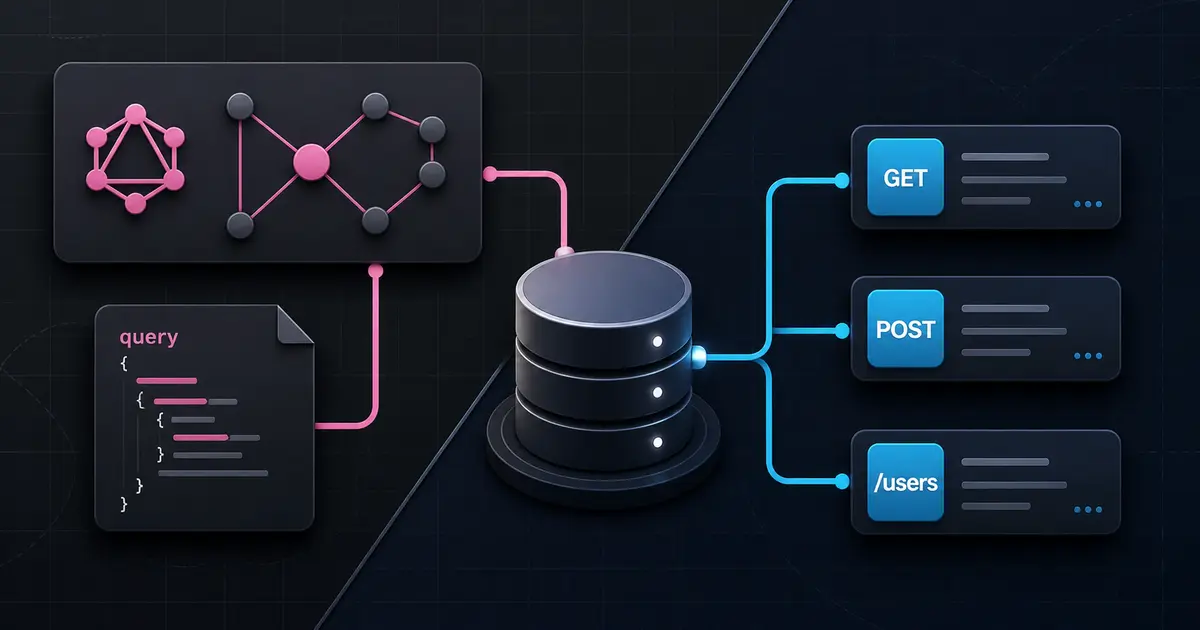
TL;DR: REST remains the safer default for public CRUD APIs, simple integrations, HTTP caching, and teams that value operational simplicity. GraphQL earns its complexity when several clients need different views of deeply connected data and frontend teams need to evolve queries independently. Many mature systems use both, with GraphQL at a product-facing aggregation layer and REST behind services.
Why this decision is still difficult
GraphQL and REST are often presented as competing technologies, but they solve different parts of API design. REST is an architectural style built around resources, HTTP semantics, and predictable representations. GraphQL is a typed query language and execution runtime that lets a client describe the shape of the response.
The difficult part is not writing the first endpoint or schema. It is operating the API after clients, mobile releases, third-party consumers, caches, permissions, dashboards, and support processes depend on it. The right choice depends on the shape of your data, the number of clients, how much query freedom you can safely expose, and whether your team can operate the associated tooling.
The core difference
A REST API usually exposes resource-oriented endpoints:
GET /api/projects/42
GET /api/projects/42/members
GET /api/projects/42/activity?limit=20
The server decides the response shape for each endpoint. HTTP methods, status codes, caching headers, and URLs provide a shared vocabulary understood by browsers, proxies, SDKs, and monitoring tools.
GraphQL commonly exposes one endpoint. The client sends a query describing the fields it needs:
query ProjectOverview($id: ID!) {
  project(id: $id) {
    id
    name
    members {
      id
      name
      role
    }
    activity(limit: 20) {
      id
      type
      createdAt
    }
  }
}
The schema defines the available types and fields, while resolvers assemble the response. This can eliminate over-fetching and multiple round trips, but it moves complexity into query planning, resolver performance, caching, authorization, and cost control.
Comparison table
| Dimension | REST | GraphQL |
|---|---|---|
| Response shape | Server-defined per endpoint | Client-selected from a schema |
| Caching | Natural HTTP and CDN cache keys | Requires persisted queries or application caching |
| Public integrations | Familiar and broadly supported | Requires GraphQL client and schema knowledge |
| Nested data | Often multiple endpoints | One query can traverse relationships |
| Abuse control | Endpoint-level limits are straightforward | Query depth and complexity need explicit limits |
| Versioning | URL, header, or additive evolution | Schema deprecation and compatibility discipline |
| Observability | Endpoint metrics are simple | Field and operation-level metrics are needed |
When REST is the better default
Choose REST when your API exposes clear business resources, most clients need similar representations, or external developers will consume it. REST is also a strong fit for file uploads, webhooks, asynchronous jobs, public partner APIs, and service-to-service contracts where explicit operations are valuable.
HTTP caching is a major practical advantage. A GET /products/42 response can be cached by a browser, CDN, or reverse proxy using standard headers. Idempotency, conditional requests, status codes, and request tracing are familiar to every platform team.
REST also limits query freedom by default. That makes it easier to reason about expensive joins, authorization, rate limits, and capacity. A well-designed REST API can still provide tailored endpoints such as /dashboard or /mobile-feed when a screen needs an optimized representation.
When GraphQL is worth the complexity
GraphQL is useful when one product has several clients with different data needs, such as web, iOS, Android, and partner surfaces. It is also attractive for complex screens that combine data from multiple domains. A single typed operation can reduce client coordination and allow a frontend to request only the fields it renders.
GraphQL can act as a backend-for-frontend aggregation layer. It does not mean every internal service must become GraphQL. Resolvers can call existing REST APIs, databases, and queues while exposing a product-specific schema.
The tradeoff is operational. A client can send a deeply nested query that triggers hundreds of database calls unless you enforce depth, complexity, pagination, and timeouts. A schema is an API contract, but it does not automatically make every resolver efficient or every field safe.
Prevent GraphQL's N+1 problem
The classic production failure happens when a list resolver loads each related object separately. A query for 100 projects may cause one query for projects and 100 queries for owners.
Use batching and caching at the request level with a DataLoader-style abstraction:
const ownerLoader = new DataLoader(async (ids: readonly string[]) => {
  const owners = await userRepository.findByIds([...ids]);
  const byId = new Map(owners.map((owner) => [owner.id, owner]));
  return ids.map((id) => byId.get(id) ?? null);
});

const project = {
  owner: (parent: Project, _args: unknown, ctx: Context) => ctx.ownerLoader.load(parent.ownerId),
};
Add query plans and database indexes before tuning resolver code. Measure database calls per operation, resolver latency, response size, and cache hit rate. Do not hide an unbounded query behind a flexible schema.
Caching and performance
REST can use URL-based caching, but it can still be slow if endpoints perform expensive work. GraphQL can be fast, but it needs deliberate caching. Common approaches include persisted queries, operation-level caches, field-level caches for stable reference data, and normalized client caches.
Persisted queries are valuable for public or high-volume clients because the server accepts only known operation hashes. They reduce request size and make query cost predictable. For mutable data, combine short TTLs with event-driven invalidation where freshness matters.
Compare the two architectures with production-like requests, not a toy benchmark. Measure p50 and p95 latency, database load, payload size, cache behavior, cold starts, and the number of network round trips for the actual screens your users care about.
Security and authorization
In REST, authorization is commonly attached to a route and resource. In GraphQL, authorization must be enforced at the field and object boundary as well as the operation boundary. A user may be allowed to read a project but not its billing fields or private notes.
Never rely on the client omitting a sensitive field. The resolver or data access layer must enforce the rule. Disable introspection in environments where it creates unnecessary exposure, use persisted queries for sensitive APIs, and apply depth, complexity, timeout, and response-size limits.
GraphQL errors need care because partial responses can contain both data and errors. Avoid revealing internal exception messages, database identifiers, or authorization details. Record the operation name and a redacted query fingerprint for observability.
Versioning and evolution
REST teams often version URLs or headers, but additive changes and deprecation can avoid frequent major versions. GraphQL commonly evolves one schema by adding fields and marking old fields as deprecated. Neither approach permits removing fields while active clients depend on them.
Track client usage before deprecating an endpoint or field. Publish migration documentation and give consumers a deadline. The API contract should be tested against real client fixtures, not only server unit tests.
A hybrid architecture is often best
A practical SaaS architecture may use REST for authentication, file uploads, webhooks, public partner integrations, and worker control APIs. GraphQL can sit above domain services to serve a complex product UI. Internal services may continue using REST or event contracts.
This avoids forcing one protocol onto every problem. It also lets teams adopt GraphQL where its flexible read model pays off without making uploads, callbacks, or operational endpoints harder to understand.
Decision framework
Ask these questions:
- Do different clients need substantially different fields and nesting?
- Will a flexible query allow clients to create unpredictable database work?
- Is HTTP caching or CDN delivery central to the workload?
- Will external developers need a simple integration path?
- Can the team operate schema tooling, persisted queries, and resolver metrics?
- Can authorization be enforced consistently at field and object boundaries?
Choose REST if most answers favor predictability and broad compatibility. Choose GraphQL if client composition and data-shape flexibility are persistent product constraints. Choose both when the boundary between product aggregation and resource APIs is clear.
Common mistakes
- Choosing GraphQL to avoid designing a domain model.
- Treating one endpoint as automatically simpler than many resource endpoints.
- Ignoring N+1 queries and query complexity limits.
- Returning every database field through a schema.
- Assuming GraphQL caching works like HTTP caching without extra design.
- Versioning REST URLs or removing GraphQL fields without checking client usage.
Production checklist
- The API style matches client diversity and data shape.
- REST resources or GraphQL types have explicit ownership.
- Pagination, limits, timeouts, and rate limits are defined.
- GraphQL depth, complexity, persisted queries, and batching are configured.
- Authorization is enforced at the data boundary.
- Caching and invalidation behavior are tested.
- Client usage is measured before deprecation.
- API documentation and contract tests are maintained.
Conclusion
REST is still an excellent default, while GraphQL is a powerful tool for complex client-driven reads. The best architecture is the one that makes performance, security, and evolution predictable for your product. SoftwareCrafting’s API design and architecture service can help evaluate the data model, client needs, and operational tradeoffs before implementation.
For the fundamentals, continue with What is GraphQL? and What is a REST API?.