
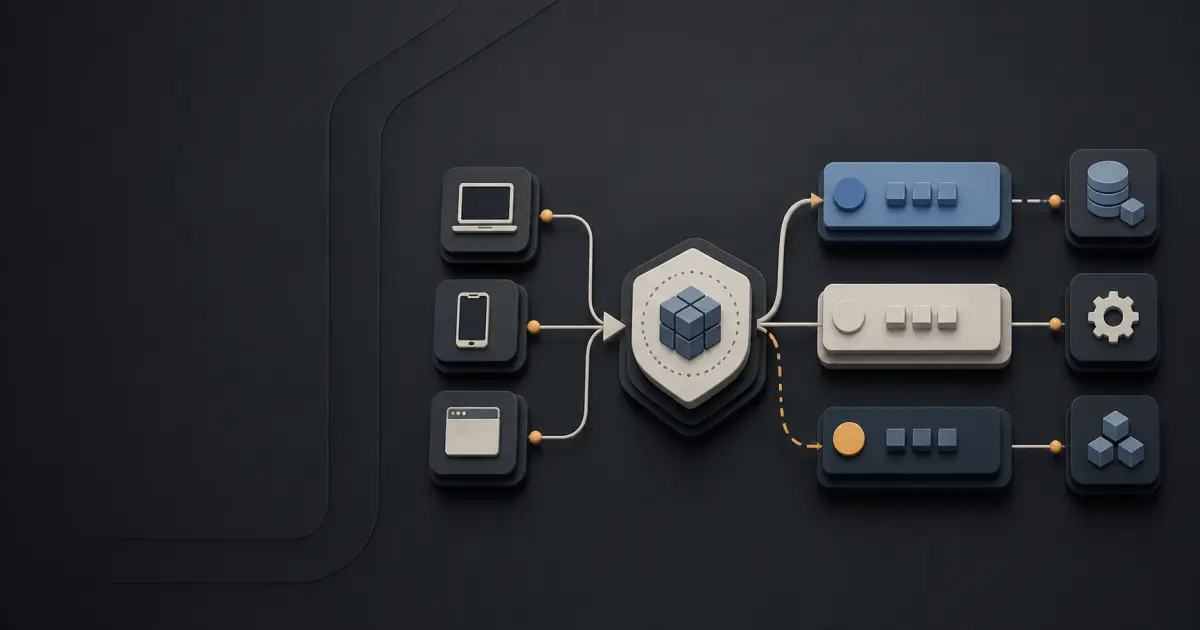
TL;DR: Treat API versioning as a product and compatibility policy, not only a URL convention. Prefer additive changes, define what counts as breaking, publish a deprecation window, test old and new contracts, and give clients a measurable migration path before removing anything.
Why API Versioning Becomes a Product Problem
An API can look like a collection of HTTP endpoints, but for its consumers it is a long-lived contract. Mobile applications may remain installed for months. A partner integration may be deployed by a different company. Internal services may upgrade on separate schedules. Once clients depend on your response fields, status codes, pagination rules, and error shapes, changing them has a cost even when the new design seems cleaner.
API versioning gives teams a controlled way to improve a contract while respecting clients that cannot upgrade immediately. It does not make every change safe. It creates a process for identifying compatibility risk, communicating change, running multiple contract versions when needed, and eventually retiring old behavior.
If you are designing a new platform, involve an API design and architecture team before endpoints spread across multiple services. A small investment in resource modeling and error conventions is easier than coordinating a breaking migration later.
Define Breaking and Non-Breaking Changes
The first versioning decision is not whether the version belongs in the URL. It is the compatibility definition your team will use during code review.
Generally safe additive changes include:
- Adding an optional response field.
- Adding a new endpoint without changing an existing one.
- Accepting a new optional request field while preserving old defaults.
- Adding a new enum value only when clients are required to handle unknown values safely.
- Adding a new pagination link or metadata field.
Changes that commonly break clients include:
- Removing or renaming a response field.
- Changing a field from a number to a string, or from a nullable value to a required value.
- Making an optional request field mandatory.
- Changing the meaning of an existing status code or error code.
- Reordering results when clients assumed a stable ordering.
- Tightening validation so previously accepted requests now fail.
- Changing authentication, rate-limit, or pagination behavior without notice.
The phrase “optional response field” still needs care. Some clients deserialize strictly, compare snapshots, or render every field they receive. Document the expected tolerance of every official SDK and test real client behavior where the ecosystem is important.
Choose a Versioning Strategy
There is no universal winner. Select one strategy, apply it consistently, and make it visible in documentation and observability.
| Strategy | Example | Strength | Tradeoff |
|---|---|---|---|
| URI path | /api/v2/orders | Easy to see, cache, route, and debug | Duplicates routes and can encourage coarse releases |
| Query parameter | /orders?version=2 | Simple to introduce beside an existing API | Easy to omit, and cache keys need careful configuration |
| Custom header | Accept: application/vnd.company.orders.v2+json | Keeps resource URLs stable and supports content negotiation | Less visible in browsers and manual debugging |
| Media type header | Accept: application/json; version=2 | Explicit representation contract | Requires consistent gateway, client, and tooling support |
For many public REST APIs, a major version in the path is a pragmatic starting point because support, monitoring, and incident response teams can identify traffic quickly. Header-based versioning can be elegant for mature platforms with strong SDKs and disciplined HTTP tooling. Avoid supporting several strategies at once unless there is a clear migration reason.
Design the Contract Around Additive Evolution
Suppose version one returns an order like this:
{
  "id": "ord_123",
  "status": "paid",
  "total": 4999
}
You can usually evolve it safely by adding a currency and a structured total while retaining the original fields during migration:
{
  "id": "ord_123",
  "status": "paid",
  "total": 4999,
  "currency": "INR",
  "amount": {
    "minor": 4999,
    "currency": "INR"
  }
}
The server should define whether total remains the canonical field or becomes a compatibility alias. If both fields exist, document precedence and keep them consistent. A compatibility field that is silently computed differently from the new representation creates a long migration trap.
Use explicit error objects rather than relying on prose messages:
{
  "error": {
    "code": "ORDER_NOT_FOUND",
    "message": "The order could not be found.",
    "requestId": "req_abc123",
    "details": []
  }
}
Error codes should be stable identifiers. Messages can improve for humans, while codes support client logic, dashboards, and support workflows. Do not expose stack traces or database details simply because a new version is being introduced.
Use a Compatibility Layer When It Reduces Risk
A version adapter can translate an old request into the current internal command and translate the current domain result back into the old response shape. This lets the business logic remain shared while the contract-specific behavior stays at the boundary.
type CreateOrderV1 = { productId: string; quantity: number };
type CreateOrderV2 = { items: Array<{ productId: string; quantity: number }>; currency: string };

function toCurrentCommand(input: CreateOrderV1 | CreateOrderV2) {
  if ('productId' in input) {
    return {
      items: [{ productId: input.productId, quantity: input.quantity }],
      currency: 'INR',
    };
  }

  return input;
}
The adapter should not become a second domain layer. Keep it focused on validation, field mapping, defaults, and representation. If versions have genuinely different business rules, model those rules explicitly and test them separately.
Plan Deprecation Before You Launch a Version
A version is not complete when the new endpoint is deployed. It is complete when clients know how to adopt it and operators know when the old version can be removed.
Define these items for every deprecated version:
- The date the replacement becomes available.
- The minimum supported period for the old version.
- The breaking changes and exact migration steps.
- SDK releases, examples, and test environments.
- Usage reporting by client, endpoint, and version.
- The final shutdown date and escalation process.
Return deprecation signals where appropriate. A Deprecation response header can identify the old behavior, while documentation and dashboard alerts should carry the human-readable migration plan. Do not depend on a header alone. Many clients never surface it to the team that owns the integration.
Track version usage with dimensions such as API version, client ID, SDK version, endpoint, status code, and latency. Avoid logging tokens or personal data. When an old version has low traffic, contact the remaining consumers before scheduling removal. “Only 2 percent of traffic” may still represent a critical enterprise customer.
Test Every Supported Contract
Versioning without tests is a promise that will decay under normal refactoring. Use several layers:
- Schema tests validate required fields, types, formats, and enums.
- Contract tests run consumer expectations against the provider.
- Golden response tests protect important representations without asserting irrelevant ordering.
- Integration tests cover authentication, pagination, errors, idempotency, and rate limits.
- Migration tests send realistic v1 requests and verify the compatibility adapter.
- Load tests confirm that supporting two versions does not overload a shared dependency.
For critical integrations, publish machine-readable OpenAPI documents for each supported version. Run breaking-change detection in CI and make exceptions explicit in a reviewed migration plan.
Common Mistakes
The most expensive mistakes are usually organizational rather than syntactic:
- Creating a new version for every small feature instead of using additive evolution.
- Copying the entire service for v2 and allowing behavior to drift.
- Deprecating without identifying traffic owners.
- Treating documentation as an afterthought.
- Forgetting webhooks, exports, SDKs, and background jobs when changing a resource.
- Returning different authorization or error behavior in different versions without documenting it.
- Removing fields because internal code no longer needs them even though clients still do.
Production Readiness Checklist
Before releasing a new API version, confirm that:
- Breaking changes are listed and reviewed.
- Version selection is deterministic and documented.
- Authentication, authorization, rate limits, and idempotency rules are covered.
- OpenAPI schemas, SDKs, examples, and changelog entries are published.
- Both versions have contract and integration tests.
- Dashboards show traffic, errors, latency, and client adoption by version.
- Deprecation headers and support guidance are ready.
- The removal date has an owner and an escalation plan.
API versioning works best as a steady compatibility discipline. Keep the contract stable where possible, isolate representation changes at the boundary, and use usage data to guide migrations. If your API needs a deeper review, SoftwareCrafting’s backend development services can help turn endpoint growth into a maintainable platform architecture.